
Margaret Preston may have been roasted on a spit for daring to present Adam and Eve as an Aboriginal couple in offering this painting to the Blake Prize in the early 1950s. How dare one assume that our forefathers had anything to do with Aboriginality!!! Thus spake the right-wing factions of our country So how…
Month: September 2015
George Orwell Language and Politics
The key question we explored today was the link between Orwell’s view of the corruption of language in his essay “Politics and the English Language” and his tirade against the forces deliberately corrupting language in his dystopian novel 1984. Is there any kind of link between Orwell’s observations about the uses and abuses of language in these two…
Oz Poetry in the later 20th Century
Today we covered a huge range of Oz writers: Rosemary Dobson, Francis Webb, Gwen Harwood, David Malouf (his poetry), Barbara Hanrahan, Les Murray, Michael Dransfield, Yahia Al-Samaway, Kevin Hart, Judith Beveridge, Kate Grenville and finally Chi Vu (her “A Psychic Guide”). Rosemary Dobson’s amazing Ekphrastic poem “Child with a Cockatoo” (based on a painting by…
Patrick White and William Blake
Patrick White’s Riders in the Chariot begins with a quote from Blake’s The Marriage of Heaven and Hell. Blake quotes the prophets Isaiah and Ezekiel in their roles as prophets decrying the materialism of the world in which they live and demonstrating how it is possible to discover the infinite in everything. Theirs is a cry of lamentation…
George Orwell in the Mid Twentieth Century
George Orwell was deeply conscious of the way in which language can be both an instrument of freedom as well as oppression. He saw how the political violence that rose with the Twentieth Century was based essentially on an abuse of language. For example the ways in which imperialist powers in the 19th and early…
Oz Lit in the Twentieth Century
Patrick White was the focus of much of today’s lecture. His essay “The Prodigal Son” (1958) gives a wonderful account of why White came back to Australia after nearly 20 years in Europe. He describes his response to a materialistic, spiritually dead culture and yet sets out his determination to make a difference to this…
William Blake in Sydney: Blake’s “Job” in the NSW Art Gallery; Brett Whiteley’s “Grain of Sand” in Surry Hills.
What a fabulous connection was made today with creative genius at its source in William Blake’s (1828) original engravings for The Book of Job (1828) at the Art Gallery of NSW and in Brett Whiteley’s creative masterpiece Alchemy (1971-1972), displayed in the actual Studio occupied by Brett Whiteley during the last years of his life: So it…
Francis Webb Commemorative Reading of his Poetry- this Saturday 12 September, 2015.
Hi all, this Saturday afternoon, if you live near Chatswood you might take yourselves off up to the Willoughby Library where there is a special commemorative event on the poet Francis Webb. I will be leading off the readings and discussions since I am the biographer of Francis Webb and have been asked to say…
Early Twentieth Century Modernism: T.S. Eliot, Katherine Mansfield, Dylan Thomas
Blog Topics for the Modernism Week 7 T. S. Eliot’s (don’t miss this link!) poem The Waste Land ends with the line “these fragments I have shored against my ruin”. This line has given its name to a new APP that has just come onto the market. Write a short review of this amazing APP and…
Early Twentieth Century Writers in Australia
We will be looking at some of these authors more closely next week, so to whet your appetites why not try one or two of these blog topics. REMEMBER ALSO YOU MUST COMPLETE AT LEAST ONE PEER REVIEW EACH WEEK. THESE WILL COUNT TOWARDS YOUR FINAL ASSESSMENT. BE BRAVE, BOLD AND ADVENTUROUS: TELL YOUR PEER…
Blake’s The Book of Job and Brett Whiteley’s Alchemy
We are entering two weeks where the following two creations are going to be explored and contrasted. Blake’s Illustrations to the Book of Job are one of the most extraordinary sacred documents in which a poet/ artist reinterprets one of the most ancient and well-known classic religious texts along the lines of his own unique…
Twentieth Century Week 6: Literary Modernism
So finding our way back from the visual, experiential feast of the NSW Art Gallery we plunge our way into the texts of the modernists of the early 20th Century. These include T.E. Hulme, F.S. Flint, Ezra Pound, H.D. and Mina Loy. Names to conjure with! And following on from these Virginia Woolf with her…
Late Colonialism in Australian Literature and Art
What a feast of writers and artists we have been digesting in this last week (Page references are to the Macquarie Pen Anthology of Australian Literature):
Ada Cambridge with her wonderfully strident defiance of being a simpering woman subject to male domination. Defying all stereotypes she speaks to her lover: “I may some day love a better man…. And then we must be free to kiss and part” (164). No wonder she was seen as rebellious in her day!
Then we looked at the Über-rebellious Irish Ned Kelly who certainly could string words together when he wanted to make a point about those for whom he had a particular hate (those representatives of the British legal system): “the big ugly fat-necked wombat headed big bellied magpie legged narrow hipped splaw-footed sons of Irish Bailiffs or english landlords which is better known as Officers of Justice or Victorian Police…” (224) and much more!
Then there was Dame Mary Gilmore, one of the few in this period who had a passionate regard for our Indigenous people and a real sense of what we as a community have lost by not taking care of them. Her poem “Australia” is a magnificent tribute to the ancient value of this people (predating all the most ancient civilizations) and containing within their culture the seeds of the beginning of language and poetry:
There was great beauty in the names her people called her,
Shaping to patterns of sound the form of their words;
They wove to measure of speech the cry of the bird,
And the voices that rose from the reeds of the cowal*.
(*Aboriginal word for small, tree-grown swampy depression)
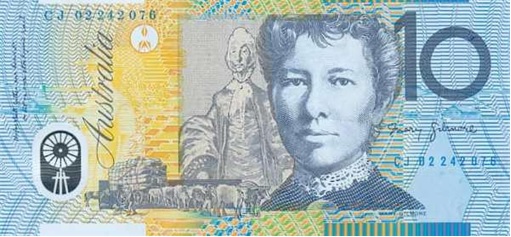
So in their traditions and culture they transformed and transmitted the beautiful voices of nature into song, into language.
We looked also at Henry Lawson, Banjo Paterson and Barbara Baynton, those authors who, in various ways, transformed the experience of Australian settlers into story and song.
And all this was done in the context of our increasing awareness of the iconic art of Tom Roberts, Arthur Streeton, Fred McCubbin, Julian Ashton and others…. what a treat!
Blog Topics for Week 6
PLEASE REMEMBER THAT YOU MUST DO AT LEAST ONE PEER REVIEW EACH WEEK AND YOU NOW HAVE THE LIBERTY TO ROAM ACROSS ALL THE LITERATURE UNITS TO PICK AND CHOSE PEOPLE TO REVIEW.
- “And then we must be free to kiss and part”. Write a short letter or poem that proclaims the kind of personal freedom that Ada Cambridge proposes in this line.
2. Write a brief description of this painting of Ned Kelly. What do you think it is saying about Ned Kelly’s status in the 20th Century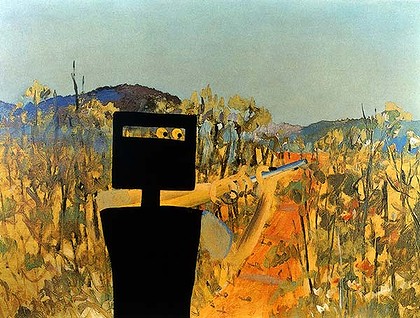
3. Write a short tribute to Dame Mary Gilmore drawing on any one of her poems (in the Pen Anthology 256-259) to show how important her ideas are to Australians.
4. Find out who the figure behind Dame Mary Gilmore is on the $10 note. What is the artistic significance of this other figure?
5. Henry Lawson or Banjo Paterson? Explain briefly your understanding of why these two authors were so different in their views of the Australian experience.
” They lie, the men who tell us in a loud decisive tone/ That want is here a stranger, and that misery’s unknown”(263)
“There was movement at the station , for the word had passed around…” (246)
6. Create your own topic, basing it around any one of the authors or painters looked at in the Late Colonial section of the unit and linking it to your own personal experience.
Enjoy!
 Michael Griffith: Home Page- Literature and Life Spring 2025
You must be logged in to post a comment.