
HI All, SLA is convening the following two events at ACU. All Literature students should come to this wonderful event. Hope to see you there! Click on the image to view all details more closely.
Language, Race and Culture : 2
Marlene Nourbes Philip and Salman Rushdie are both committed to expressing the ways in which writers can express freedom through both embracing aspects of the culture they are living in and holding onto the narratives, the modes of thinking of their own cultures. Marlene in her “Discourse on the Logic of Language” powerfully dramatizes the…
Test Post for 20th Century
This is a demonstration to show how I can put this post into a category of my choosing.
David Malouf- Fly Away Peter
In today’s lecture we spent time exploring the last few pages of this amazing novel Fly Away Peter. Malouf’s creativity is so attuned to his characters’ inner experience that it is very hard not to be deeply moved by what his characters experience. This is the power of his creative skill, shaping sentences, phrases, images to draw…
David Malouf- Remembering Babylon.
HI All, Last Blog Topics for weeks 10 and 11. Creative Topics: 1/ Write a letter to Jock McIvor explaining to him how you yourself have been going through some deep personal self-questioning, trying to work out whether the company you keep is in the best interests of your own personal growth. 2/ Write a letter to…
Language, Race and Culture: ways of transforming xenophobia
A key theme from our topic today was the way in which creativity in all the arts (poetry, music, visual arts…) can be a way in which marginalized and oppressed peoples can reassert their individuality and their importance as human beings. Prejudice is insidious and the most common response is fear and buried hatred, but…
Patrick White’s Aboriginal Jesus
Margaret Preston may have been roasted on a spit for daring to present Adam and Eve as an Aboriginal couple in offering this painting to the Blake Prize in the early 1950s. How dare one assume that our forefathers had anything to do with Aboriginality!!! Thus spake the right-wing factions of our country So how…
George Orwell Language and Politics
The key question we explored today was the link between Orwell’s view of the corruption of language in his essay “Politics and the English Language” and his tirade against the forces deliberately corrupting language in his dystopian novel 1984. Is there any kind of link between Orwell’s observations about the uses and abuses of language in these two…
Oz Poetry in the later 20th Century
Today we covered a huge range of Oz writers: Rosemary Dobson, Francis Webb, Gwen Harwood, David Malouf (his poetry), Barbara Hanrahan, Les Murray, Michael Dransfield, Yahia Al-Samaway, Kevin Hart, Judith Beveridge, Kate Grenville and finally Chi Vu (her “A Psychic Guide”). Rosemary Dobson’s amazing Ekphrastic poem “Child with a Cockatoo” (based on a painting by…
Patrick White and William Blake
Patrick White’s Riders in the Chariot begins with a quote from Blake’s The Marriage of Heaven and Hell. Blake quotes the prophets Isaiah and Ezekiel in their roles as prophets decrying the materialism of the world in which they live and demonstrating how it is possible to discover the infinite in everything. Theirs is a cry of lamentation…
George Orwell in the Mid Twentieth Century
George Orwell was deeply conscious of the way in which language can be both an instrument of freedom as well as oppression. He saw how the political violence that rose with the Twentieth Century was based essentially on an abuse of language. For example the ways in which imperialist powers in the 19th and early…
Oz Lit in the Twentieth Century
Patrick White was the focus of much of today’s lecture. His essay “The Prodigal Son” (1958) gives a wonderful account of why White came back to Australia after nearly 20 years in Europe. He describes his response to a materialistic, spiritually dead culture and yet sets out his determination to make a difference to this…
William Blake in Sydney: Blake’s “Job” in the NSW Art Gallery; Brett Whiteley’s “Grain of Sand” in Surry Hills.
What a fabulous connection was made today with creative genius at its source in William Blake’s (1828) original engravings for The Book of Job (1828) at the Art Gallery of NSW and in Brett Whiteley’s creative masterpiece Alchemy (1971-1972), displayed in the actual Studio occupied by Brett Whiteley during the last years of his life: So it…
Francis Webb Commemorative Reading of his Poetry- this Saturday 12 September, 2015.
Hi all, this Saturday afternoon, if you live near Chatswood you might take yourselves off up to the Willoughby Library where there is a special commemorative event on the poet Francis Webb. I will be leading off the readings and discussions since I am the biographer of Francis Webb and have been asked to say…
Early Twentieth Century Modernism: T.S. Eliot, Katherine Mansfield, Dylan Thomas
Blog Topics for the Modernism Week 7 T. S. Eliot’s (don’t miss this link!) poem The Waste Land ends with the line “these fragments I have shored against my ruin”. This line has given its name to a new APP that has just come onto the market. Write a short review of this amazing APP and…
Early Twentieth Century Writers in Australia
We will be looking at some of these authors more closely next week, so to whet your appetites why not try one or two of these blog topics. REMEMBER ALSO YOU MUST COMPLETE AT LEAST ONE PEER REVIEW EACH WEEK. THESE WILL COUNT TOWARDS YOUR FINAL ASSESSMENT. BE BRAVE, BOLD AND ADVENTUROUS: TELL YOUR PEER…
Blake’s The Book of Job and Brett Whiteley’s Alchemy
We are entering two weeks where the following two creations are going to be explored and contrasted. Blake’s Illustrations to the Book of Job are one of the most extraordinary sacred documents in which a poet/ artist reinterprets one of the most ancient and well-known classic religious texts along the lines of his own unique…
Twentieth Century Week 6: Literary Modernism
So finding our way back from the visual, experiential feast of the NSW Art Gallery we plunge our way into the texts of the modernists of the early 20th Century. These include T.E. Hulme, F.S. Flint, Ezra Pound, H.D. and Mina Loy. Names to conjure with! And following on from these Virginia Woolf with her…
Late Colonialism in Australian Literature and Art
What a feast of writers and artists we have been digesting in this last week (Page references are to the Macquarie Pen Anthology of Australian Literature):
Ada Cambridge with her wonderfully strident defiance of being a simpering woman subject to male domination. Defying all stereotypes she speaks to her lover: “I may some day love a better man…. And then we must be free to kiss and part” (164). No wonder she was seen as rebellious in her day!
Then we looked at the Über-rebellious Irish Ned Kelly who certainly could string words together when he wanted to make a point about those for whom he had a particular hate (those representatives of the British legal system): “the big ugly fat-necked wombat headed big bellied magpie legged narrow hipped splaw-footed sons of Irish Bailiffs or english landlords which is better known as Officers of Justice or Victorian Police…” (224) and much more!
Then there was Dame Mary Gilmore, one of the few in this period who had a passionate regard for our Indigenous people and a real sense of what we as a community have lost by not taking care of them. Her poem “Australia” is a magnificent tribute to the ancient value of this people (predating all the most ancient civilizations) and containing within their culture the seeds of the beginning of language and poetry:
There was great beauty in the names her people called her,
Shaping to patterns of sound the form of their words;
They wove to measure of speech the cry of the bird,
And the voices that rose from the reeds of the cowal*.
(*Aboriginal word for small, tree-grown swampy depression)
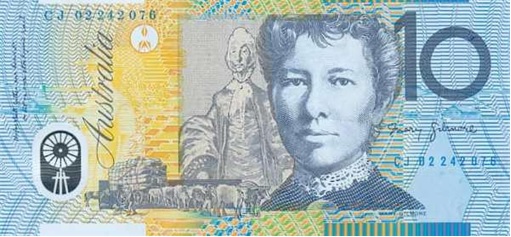
So in their traditions and culture they transformed and transmitted the beautiful voices of nature into song, into language.
We looked also at Henry Lawson, Banjo Paterson and Barbara Baynton, those authors who, in various ways, transformed the experience of Australian settlers into story and song.
And all this was done in the context of our increasing awareness of the iconic art of Tom Roberts, Arthur Streeton, Fred McCubbin, Julian Ashton and others…. what a treat!
Blog Topics for Week 6
PLEASE REMEMBER THAT YOU MUST DO AT LEAST ONE PEER REVIEW EACH WEEK AND YOU NOW HAVE THE LIBERTY TO ROAM ACROSS ALL THE LITERATURE UNITS TO PICK AND CHOSE PEOPLE TO REVIEW.
- “And then we must be free to kiss and part”. Write a short letter or poem that proclaims the kind of personal freedom that Ada Cambridge proposes in this line.
2. Write a brief description of this painting of Ned Kelly. What do you think it is saying about Ned Kelly’s status in the 20th Century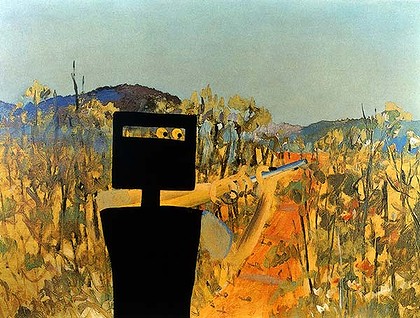
3. Write a short tribute to Dame Mary Gilmore drawing on any one of her poems (in the Pen Anthology 256-259) to show how important her ideas are to Australians.
4. Find out who the figure behind Dame Mary Gilmore is on the $10 note. What is the artistic significance of this other figure?
5. Henry Lawson or Banjo Paterson? Explain briefly your understanding of why these two authors were so different in their views of the Australian experience.
” They lie, the men who tell us in a loud decisive tone/ That want is here a stranger, and that misery’s unknown”(263)
“There was movement at the station , for the word had passed around…” (246)
6. Create your own topic, basing it around any one of the authors or painters looked at in the Late Colonial section of the unit and linking it to your own personal experience.
Enjoy!
And now for the Grand Finale (of this first trawl through Literature Blogs)!
Please find here links to the best third year blogs. These students, most in their third year of literature, are studying “The Visionary Imagination” with a focus on William Blake, Patrick White and David Malouf. Let’s hear a round of applause for the following stars all who got full, or close to full marks!! Emma…
The Marriage of Heaven and Hell: The Bible of Hell
I have also: The Bible of Hell: which the world shall have whether they will or no. For Blake The Marriage of Heaven and Hell occurs when the sanctimonious, commandment-loving Angel finally gives up his/her smug sense of superiority and happily embraces the flames of fire and joins the Devil’s party, a party which believes in the presence…
Twentieth Century Week 5: Modernism and Contemporary Art, NSW Art Gallery.
Thank you all for making our visit purposeful and entertaining. It always amazes me how many connection we can find together between the literature and the art of any particular period. Most amazing was that work by the Indian artist Jitish Kallat “Public Notice 2” (2007) that filled both sides of the main entrance hall to the gallery.…
Most Promising Blogs from Twentieth Century Literature.
Please have a look at some of the extraordinary creative talent that is emerging in this group of chiefly second year students. I am on the warpath trying to encourage you to begin to take Vlogging seriously as a tool you can use in your own Blogs. For some interesting ideas on this please see some…
Early Colonialism in Australia
My Hero: Charles Harpur Frank the Poet, Matthew Flinders, Barron Field, Charles Sturt, Eliza Dunlop, Charles Harpur, Henry Kendall, Louisa Anne Meredith, Catherine Helen Spence…. what a great line-up for early colonial Australian writers! These writers revealed many of the core features of the early colonial era: the strange way in which the flora and…
Most Promising First Year Blogs
HI All, here are links to the most promising first year (Oz Lit) Blogs. Enjoy some of this amazing creativity! https://morganjessie.wordpress.com/ https://annemariedimarco.wordpress.com/ https://benbotella.wordpress.com https://lauranema1.wordpress.com/ https://amarienguyen.wordpress.com https://asiyatrad.wordpress.com/ https://caitlyntuckerman.wordpress.com https://ninarwalker.wordpress.com
The Doors of Perception: Heaven and Hell
The song “End of the Night” by The Doors was directly inspired by Blake’s “Auguries of Innocence” especially the lines “Realms of bliss, realms of light, some are borne to sweet delight, some are borne to sweet delight, some are borne to the endless night.” Listen to the Doors singing “End of the Night” here. William Blake takes…
The Poetry of the First World War- 20th C Lit Week 4!
The poetry of the First World War is always compelling in that it forces me to step out of my comfort zone and confront the harsh reality of utterly futile death, as expressed so painfully and powerfully in Wilfred Owen’s “Futility” Move him into the sun— Gently its touch awoke him once, At home, whispering…
Australian Literature Art Gallery Visit- 2015 (Week 4)
What a great turn-out for this visit! Thank you all for your keen participation. We covered a wealth of material in the allocated hour from early 19th Century through to contemporary and Indigenous Art. Hoping that this will provide lots of useful insight for your final assessment! I have attached the audio talkl tour here…
William Blake in his letters and notebooks- Week 3
In his letters William Blake gives some startling revelations about how he sees the world, not through “single vision”, but through “fourfold vision”. He expresses this in a way that gives real insight into how he saw and experienced the world, a way that is far from what most of us are capable of knowing.…
Everyman- Review of National Theatre Live Production
As a group we went yesterday to see poet laureate Carol Ann Duffy’s new translation of Everyman with Chiwetel Ejiofor in the title role and movement by Javier De Frutos. The original morality play called Everyman (written in the late 15th Century) was a play designed to remind people of their mortality. It was designed to…
All Quiet on the Western Front- The Horrific Impact of War
The Death of Kemmerich All Quiet on the Western Front 1930 Erich Maria Remarque is an author whose message and appeal is universal. Read by Germans, French, English or Americans it spells out the tragic impact of war on the ordinary soldier. But what it also powerfully shows is that in the teeth of war, in…
Oz Lit Week 3: Writing by and about Indigenous authors.
What a treat this week to hear so much about the indigenous experience. Starting with Bennelong, Watkin Tench and Eleanor Dark’s fictionalisation of these characters we learnt of the tenuous attempts of two radically different societies to get to know one another. Tench emphasises the “gentleness and humanity” of the natives, and this is something…
Sydney Spring Starts in August: What a Treat!
A walk across the ridge above Galston Gorge this morning reveals a landscape spectacularly clothed in colours and new life. Be sure to click on the images to get full resolution. Boronia Ledifolia (Sydney Boronia) covers the ground in bursts of pink: The white Grevillia is an unusual sight on this ridge: And here is a magnificent…
William Blake – Week 2
William Blake was a radical in countless ways: political, religious, personal. He dared to confront and question received knowledge and forced his readers then and now to ask questions about the nature of God, the Universe and everything in it. Among many aspects of his creative life we explored closely today this contrasting vision of…
Mistah Kurtz- he dead.
We had really good conversations today on the question of whether Conrad was a racist or not. Your thoughts seemed very much in the balance on this question. But I think the answer lies somewhere in the middle. His main focus is on the “Darkness” at the heart of contemporary civilisation with its exploitative cast…
Oz Lit Week 2: Bobby Wabalanginy Fights Back!
We had a fabulous time exploring the core differences between the way indigenous Australians and European intruders experience the world around them. Kim Scott has done a fabulous job in using language that in its texture indicates the kinds of experience that his characters have. As a blog topic for next week, Try to describe…
The Visionary Imagination Week 1 2015: Seeing through not with the eye.
A great start to the semester! So glad to see the level of interest and attention to these important ideas, to these amazing composite art works of William Blake. Here are the complete visual images of the Nurse’s Songs in The Book of Innocence and The Book of Experience (always click on the image for…
Twentieth Century Literature 2015 Week 1
We got off to a great start today. Thank you for your concentrated attention and your willing participation in what we are exploring together. The 20th Century is one of the most momentous periods from the point of view of radical changes taking place in the way people think, feel and create. It is important…
Week One- and Blog Topics for your Week Two
Hi All, we are off to a very good start. Our tutorials managed to uncover some really interesting differences between the way the landscape was viewed in the early 19th Century and then in the early 20th Century. Mitchell and Lawrence make a very useful comparison. Mitchell is tied to language and ideas that he…
Welcome to Spring Semester, students in: Oz Lit, Twentieth Century & Visionary Blake
l am very much looking forward to working with you all in these three fabulous units. Oz Lit (otherwise known as Australian Literature) will take us on an amazing tour of the creativity produced in this, our, country over the past 200 years and more… Twentieth Century will engage us with the literature from around…
Best WordPress ePortfolios for Autumn 2015: Shakespeare and the Nineteenth Century
These students have been blogging as they have been studying Nineteenth Century Literature and The Age of Shakespeare. Some of these students have been doing both courses. They each had to showcase their best blogs and also write a Summative Comment explaining what they have learned from the course and how the content still has…
Bush Walking, Literature: An Introduction, Nineteenth, Shakespeare Plus, Visionary Blake, x Blogging
Grounding the Sacred: Don’t Miss This Event- Musicians, Artists, Novelists, Poets Engaging With the Sacred
Please Click to Register for this Amazing Conference Learn more at Grounding the Sacred through Literature and the Arts Conference.
Budjwa Bay: Muoagamarra Nature Reserve Near Cowan, NSW- Early Sunday Morning Walk
The image at the top of this site is Budjwa Bay as it manifested itself on this cold, wet winter morning. But the stillness, the freshness was deafening, except for the multi-coloured calls of the Lyre Birds from across the water. Here is a place to sit and absorb the quiet round about and hear the quiet inside. What…
Winter is upon us! But the Bush is still a fabulous place to enter…
Made it to the top of the ridge above Galston, early on Saturday morning. The air was fresh and there were beautifully icy mists swirling up from the Gorge to the valley tops (click on all images to get stunning resolutions): On the ridge tops there was an amazing array of winter flowering plant life:…
Literature: An Introduction, Nineteenth, NSW Art Gallery, Performances, Shakespeare Plus, x Blogging
Final Night Clemente/ Catalyst Students at Mission Australia Surry Hills: Shakespeare
Arthur Enfield (Stained Glass) The Seven Ages of Man (Shakespeare As You Like It), State Library of NSW. What a fabulous outcome! All our doubts, uncertainties, wrestling with difficult words, produced an amazing and satisfying presentation of sections of As You Like It. This was the culmination of our course Introduction to Literature which ran for 12 weeks: 4…
Han Solo & Princess Leia visit Oscar Wilde and Bernard Shaw
Let the Force Be with You Two Star-War Celebrities, Princess Leia and Han Solo visited and adjudicated the 8 performances from Oscar Wilde’s The Importance of Being Earnest and Bernard Shaw’s Mrs Warren’s Profession today in Murray Hall. The association between Star Wars and these two classic drama pieces is completely random although one could argue that George…
Wilde, Shaw, Jagger and the Challenge to a Dysfunctional Society
Oscar Wilde’s biographer Richard Ellman tells us that “From as early as 1881 … literary London was put out of countenance by this outrageous Irishman … who declared he was a socialist and hinted he was a homosexual, while patently mocking wise saws on all subjects. He declined, in a public and ceremonious manner, to live…
An Event Not to be Missed: Grounding the Sacred in Literature and the Arts at ACU July 23-26th
In July this year (23-26) we are co-ordinating an international conference on the links between Literature, the Arts and the Sacred. We have an amazing line-up of participants including David Malouf, Genevieve Lacey, Kevin Hart, Vivien Johnson, Kathleen Deignan, David Jasper, Imam Afroz Ali, Maeve Heaney, Carmel Bird, Michael McGirr, Joelene Griffith and many more.…
Shakespeare the Magician, Transforming A World of Enmity into a Holy Place- The Tempest
In The Tempest Shakespeare takes on all the hostility in the world and uses the extraordinary magic of his art to transform hostility into love- then and now! This is in fact the signature of all his comedies and romances and maybe even the implied cathartic outcome of that series of desperate tragedies (Othello, King Lear,…
All the World’s a Stage – and are we really nothing but players?? Rehearsals! Clemente/Catalyst students
In 3 weeks time the Clemente/ Catalyst students have to present extracts from As You Like It to a public audience at the MAC (Mission Australia Centre) Surry Hills. We are going to begin with a dramatised reading of Jacques’s speech (perhaps the most famous speech in all of Shakespeare): “All the world’s a stage, And all…
 Michael Griffith: Home Page- Literature and Life Spring 2025
You must be logged in to post a comment.